
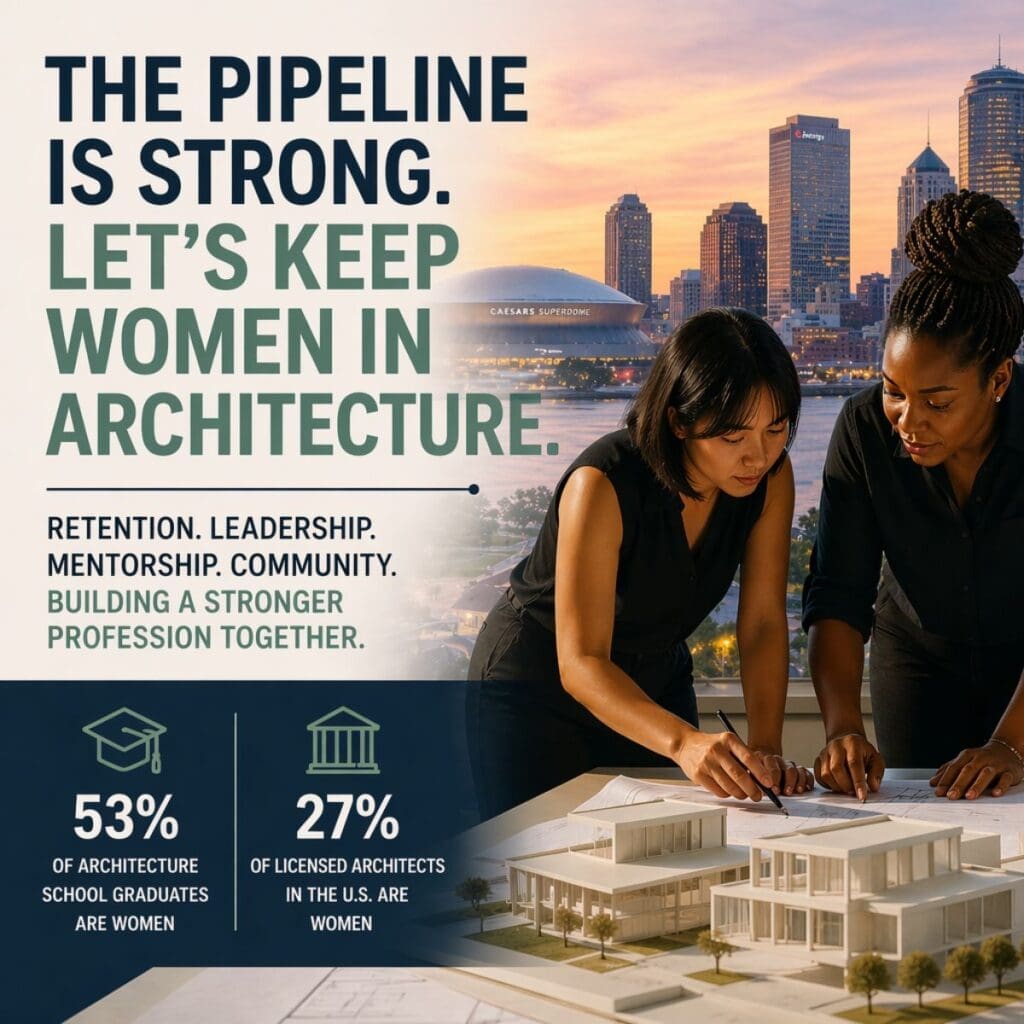

When it comes to women, architecture does not have a pipeline problem—it has a retention and leadership problem, and mentorship, community, and professional engagement are key to solving it.
When I graduated from Tulane’s School of Architecture in 1998, women already made up about half my class. Even then, it wasn’t a pipeline problem. The issue is no longer getting women into architecture school; it is making sure they remain in the profession long enough to become licensed architects, firm leaders, and mentors to the next generation.
A lot has changed in twenty-five years—and somehow, not enough. Today, women make up approximately 53% of architecture school graduates nationwide. Here in New Orleans, that number is even more striking: at Tulane’s School of Architecture and the Built Environment, women now make up approximately 59% of the student body. The pipeline is strong, and the future of the profession clearly includes many talented women.
But if women are graduating from architecture school in such high numbers, another statistic tells a very different story: only about 27% of licensed architects in the United States are women. That gap—between 53% of graduates and 27% of licensed architects—tells us something important. This gap suggests that the issue facing the profession is less about the pipeline into architecture and more about retaining and advancing women throughout their careers.
The profession has made meaningful progress in visibility and participation, but the internal structure of practice still tells a different story. As highlighted in “Women in Architecture: Progress, Gaps, and the Work Still Ahead” (ArchDaily, February 2024), women now represent a growing share of architecture students and early-career professionals, yet they remain significantly underrepresented in licensure and firm leadership roles. The article also identifies a “mid-career attrition gap,” where many women leave the profession before reaching senior leadership positions—a key factor contributing to this disparity.
There is no single reason women leave architecture, but recurring challenges are frequently discussed across the profession, including demanding work hours, inequities in advancement, the impact of caregiving responsibilities, the lengthy licensure process, compensation concerns, and a lack of mentorship and leadership opportunities.
These issues not only affect women, but they also affect the profession as a whole; retention and leadership are key to the long-term strength of architecture.
In a city like New Orleans, architecture plays an especially important role. Our profession shapes hospitals, schools, housing, historic buildings, infrastructure, and the cultural fabric of our city. The buildings and spaces we design affect everyone who lives here.
The profession benefits when the people designing our built environment reflect the diversity of the communities we serve. When different perspectives are represented at the table—in design meetings, in firm leadership, and in professional organizations—the work becomes stronger and more responsive.
Organizations like AIA New Orleans and the Women in Architecture committee (WIA) play an important role locally by fostering mentorship, building professional networks, and creating pathways to leadership.
These efforts help ensure that the many talented women studying architecture in New Orleans today remain in the profession and grow into leadership roles in the future.
The future of architecture is already sitting in studios today, including right here in New Orleans. Many of those students are women. The question is not whether women belong in architecture—that question has already been answered.
The question now is whether the profession will continue to evolve in a way that allows those graduates to become licensed architects, firm leaders, business owners, and leaders of our professional organizations.
This is where WIA plays an important role—not as a separate track, but as an entry point, a support system, and a catalyst for engagement. For many women, particularly those early in their careers, the broader professional community can feel intimidating or difficult to navigate. This is not only because leadership within architecture firms has historically been male-dominated, but also because many of the people architects interact with regularly—clients, contractors, and consultants—may not look like them or share similar experiences. As a result, many women feel they must work harder to establish credibility and prove their expertise. Mentorship and professional networks become especially important in helping navigate these challenges and in showing younger professionals a path that others have successfully taken before them.
Through mentorship events, the committee brings together emerging professionals and experienced practitioners to share advice, discuss challenges, and offer perspective on everything from licensure to career advancement. These conversations are valuable not only for younger professionals, but also for experienced architects and firm owners, who gain a better understanding of the concerns, expectations, and challenges facing the next generation. That exchange helps firms and leaders better support and retain young professionals across the profession.
Informal gatherings—mixers, happy hours, and small group events—create opportunities for women across generations to build a genuine professional community. These connections become a network of support where information is shared, challenges are discussed openly, and insights about the needs of our local community and our workplaces are exchanged.
These efforts are not just about networking—they are about retention. They help ensure that the many talented women entering architecture today do not feel isolated or sidelined as their careers progress, but instead feel supported, connected, and empowered to stay, advance, and lead.
Women in Architecture as a committee still matters because the goal is not simply to see women graduate from architecture school. The goal is to see them become licensed architects, firm leaders, business owners, mentors, and leaders of our professional organizations. Until that is the norm rather than the exception, the work of Women in Architecture—and the work of improving our profession—is not finished.