
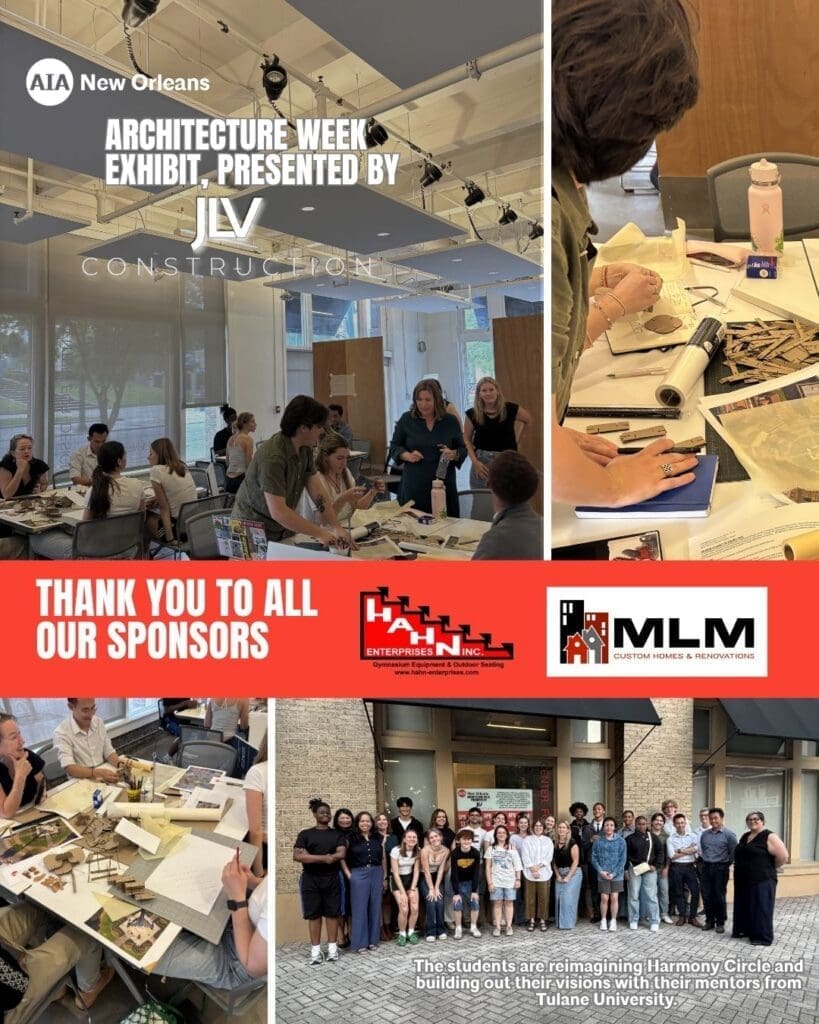
Architecture Week 2026, Presented by JLV Construction, brought together high school students from across the Greater New Orleans area for an intensive introduction to architecture, urban design, and creative problem-solving for three immersive days from April 13th through April 16th. Hosted by AIA New Orleans, the program was intentionally designed to expose young people — particularly students already interested in design, engineering, art, and construction — to the possibilities within the architecture and construction industries. More than a workshop, Architecture Week served as a pipeline program: connecting students directly with practicing architects, university mentors, and industry professionals while challenging them to think critically about how design impacts communities.
This year’s cohort included students from multiple schools across the New Orleans area who were divided into five teams and paired with mentors from Tulane University and local architecture professionals. Mentors guided students through every phase of the design process — from brainstorming and site analysis to model building and final presentations.
Throughout the week, students were challenged to reimagine Harmony Circle as a more functional, community-centered public space for New Orleans residents. (Include 2 lines about Harmony Circle’s history). The project encouraged students to think beyond aesthetics and consider how architecture shapes safety, accessibility, culture, transportation, environmental sustainability, and human interaction.
The program was led by Shawna Meyers, a professor at Tulane University School of Architecture & The Built Environment and principal at Atlier Mey. Day one focused on architectural foundations and conceptual thinking. Students were introduced to urban planning principles, scale, site analysis, and design storytelling. The students were given a design prompt that challenged them to develop a pavilion that serves our current community and takes the space that once held the divisive statue of Robert E. Lee. Through sketching exercises and collaborative discussions, teams began developing ideas around what a redesigned Harmony Circle could look like and whom the space should serve.
By day two, the studio environment transformed into a full creative workspace. Tables were covered with tracing paper, foam board, drafting tools, scaled figures, and evolving concept models as students refined their ideas with guidance from mentors. Teams explored how public green space, walkability, gathering areas, lighting, and traffic flow could improve community engagement and usability within the site.
Students contributed to design concepts that ranged from environmentally conscious public parks to interactive cultural spaces celebrating New Orleans history and identity. Several teams incorporated features such as shaded seating areas, performance spaces, water elements, bike pathways, and pedestrian-focused layouts into their final concepts.
Students weren’t just designing structures — they were thinking about how communities gather, how families interact, and how public spaces can improve quality of life. “I learned how to look at my surroundings and see the needs of people” said high school student Violetta G.
The final day culminated in formal presentations held at Tulane University’s School of Architecture before a panel of judges that included Andrew Liles, AIA; Marianne Graffam, AIA; and Chris Meyers, AIA. Each team presented design boards, architectural models, and verbal presentations explaining the purpose and functionality behind their concepts. Students were evaluated on creativity, collaboration, presentation skills, innovation, and how effectively their designs addressed community needs. “The winning design was a sophisticated account of the human-to-physical scale, and I was excited to see the high school students take that into account,” said Chris Meyers. The evening closed with students being introduced to the National Organization of Minority Architects – Louisiana Project Pipeline and Tulane School of Architecture’s Career Pathways. These two community programs connect students to the design world through a summer design curriculum for high school students.
The winning team, Aaleyah G. and Blake W. were recognized) during the closing ceremony and will also participate in this year’s Design Awards as special guests, giving students an opportunity to experience professional architectural recognition and public exhibition firsthand. In addition to the presentations, student work from Architecture Week 2026 is currently featured inside the AIA New Orleans “Teeny Tiny Gallery” facing Andrew Higgins Drive, allowing the broader public to engage directly with the students’ ideas and creativity.
For parents, Architecture Week provided a rare opportunity for students to explore architecture through real-world application rather than theory alone. Participants learned teamwork, public speaking, problem-solving, spatial reasoning, and creative communication while receiving mentorship from professionals already working within the field. For sponsors and community partners, the program demonstrated the importance of investing early in future architects, designers, engineers, and builders — especially in communities where students may not otherwise have direct access to design education or industry mentorship. Programs like Architecture Week create visibility, representation, and access while helping students understand that careers in architecture and construction are both attainable and impactful.
Presented by JLV Construction and including MLM Construction and Hahn Enterprises Inc., Architecture Week 2026 reinforced that architecture is not only about buildings, but about shaping healthier, connected communities. We are incredibly grateful to all our sponsors for their support for our first year of programming. By giving students, the tools, mentorship, and creative freedom to imagine a better New Orleans, the program continues to build a stronger future for both the design industry and the city itself.
If you missed out on participating in this year’s Architecture Week, we hope you’ll consider being a part of AIA New Orleans’ Edible Design Competition in December. Subscribe to our newsletter by clicking here and stay informed about event developments.